Most
Most product teams never run an A/B test
Designing a rigorous test loses to shipping.

Experimentation
Hypothesis in. Instrumented test with rollback out.
The category
Arvad designs sample size, instrumentation, and rollback in the same workspace so the readout is a decision you can act on, not only a dashboard screenshot.
Plain-English hypothesis becomes variants, metrics, MDE, and sample size.
Variant code ships as a PR behind GrowthBook or Statsig flags.
Guardrails on revenue, latency, and errors, with auto-rollback on breach.
Sequential analysis and a plain-English decision memo on the same build record.
The gap
Everyone wants to be data-driven. Few teams have spare capacity to run rigorous tests.
Most
Designing a rigorous test loses to shipping.
Hard
Sample size, power, MDE, peeking. Wrong tests create confident wrong decisions.
Risk
Without guardrails, a bad variant can hurt revenue quietly.
Glue
Flags platforms do not write variants, instrument metrics, or design rollback.
The experimentation pipeline most teams never finish, wired into GrowthBook or Statsig.
One-line hypothesis becomes variants, primary/secondary metrics, MDE, sample size, duration.
Stays in the workspace with plan and checks
Variant B as a real PR behind the flag, with metric instrumentation.
Stays in the workspace with plan and checks
Bayesian and frequentist methods, sequential testing, multiple-testing correction.
Stays in the workspace with plan and checks
Stratified randomization by plan, geography, device, signup date.
Stays in the workspace with plan and checks
Revenue, latency, error rate, and KPIs you pick. Cross a guardrail and auto-roll back.
Stays in the workspace with plan and checks
Every experiment ships with a tested rollback path before go-live.
Stays in the workspace with plan and checks
Decision memo: what shipped, what moved, what to do next.
Stays in the workspace with plan and checks
Bring GrowthBook or Statsig. Arvad designs, writes, and analyzes; flags stay where your data team trusts them.
Stays in the workspace with plan and checks
Arvad sits where the thread keeps the plan, staging, spend, and checks.
| Capability | DIY experimentation | Arvad experimentation |
|---|---|---|
| Time to first experiment | Weeks | Days |
| Variant code | Engineering ticket | PR behind a flag |
| Guardrails | Optional | Required, with auto-rollback |
| Stats | Ad hoc | Sequential, multi-test-corrected |
| Report | p-values in Slack | Plain-English decision memo |
| Platform | You build glue | GrowthBook / Statsig native |
Write one line, approve the design, ship instrumented variants behind a flag, decide from a memo.
Write one line, approve the design, ship instrumented variants behind a flag, decide from a memo.
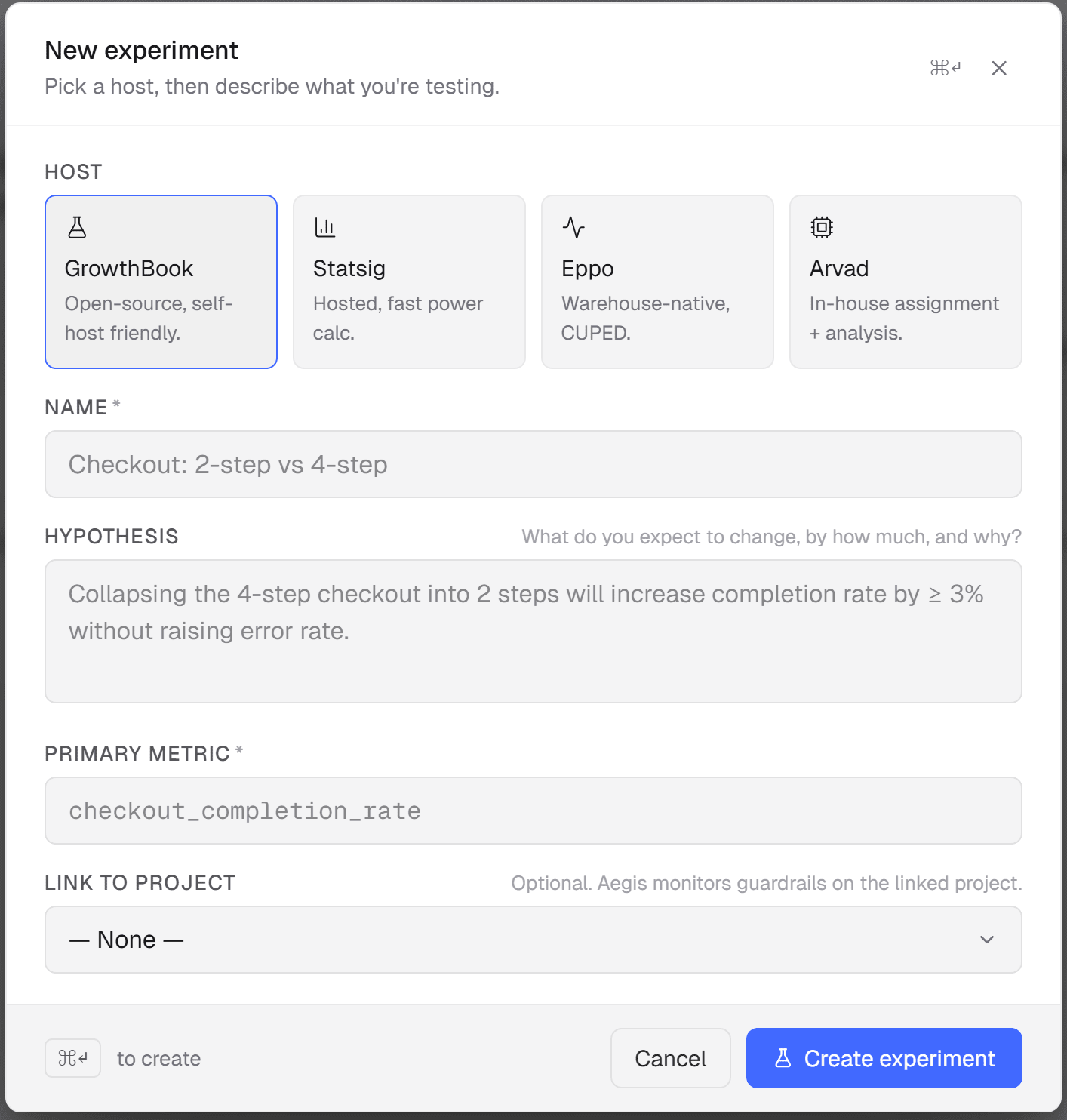
One line, plain English. “I think a softer CTA on the pricing page will lift trial-starts.” Arvad turns it into a structured proposal you can edit, no template, no PhD required.
All
Every variant ships with a tested rollback
Rollback path tested before go-live.
Sequential
Sequential analysis
Call the test when the data supports it.
≤ SLA
Latency guardrail
Breach triggers auto-rollback.
2
Two platforms on day one
GrowthBook and Statsig.
Limits stated plainly. No demo theater.
One question
If you cannot, you still have a chat log. Arvad keeps that work in one workspace.
Keep exploring
Hypothesis, variants, guardrails, and decision in one place.